
Create a follow-up
Plan a dated corrective work order from a detected anomaly; the follow-up is linked to the non-compliance and appears as a new task.
- Audience
- Administrator
- Screen
- Work order detail → "Create follow-up" dialog
- Verified version
- App 1.0.0
Goal
Create a corrective work order planned to handle an anomaly detected on a non-compliance. The follow-up is linked to the parent work order and appears in your work orders as a new task, with its own date and priority.
Audience
Administrator of the building.
Prerequisites
- The work order is Non-compliant, with a described anomaly, and not yet resolved.
- Be an administrator (the "Create follow-up" button doesn't appear for non-admins).
Steps
-
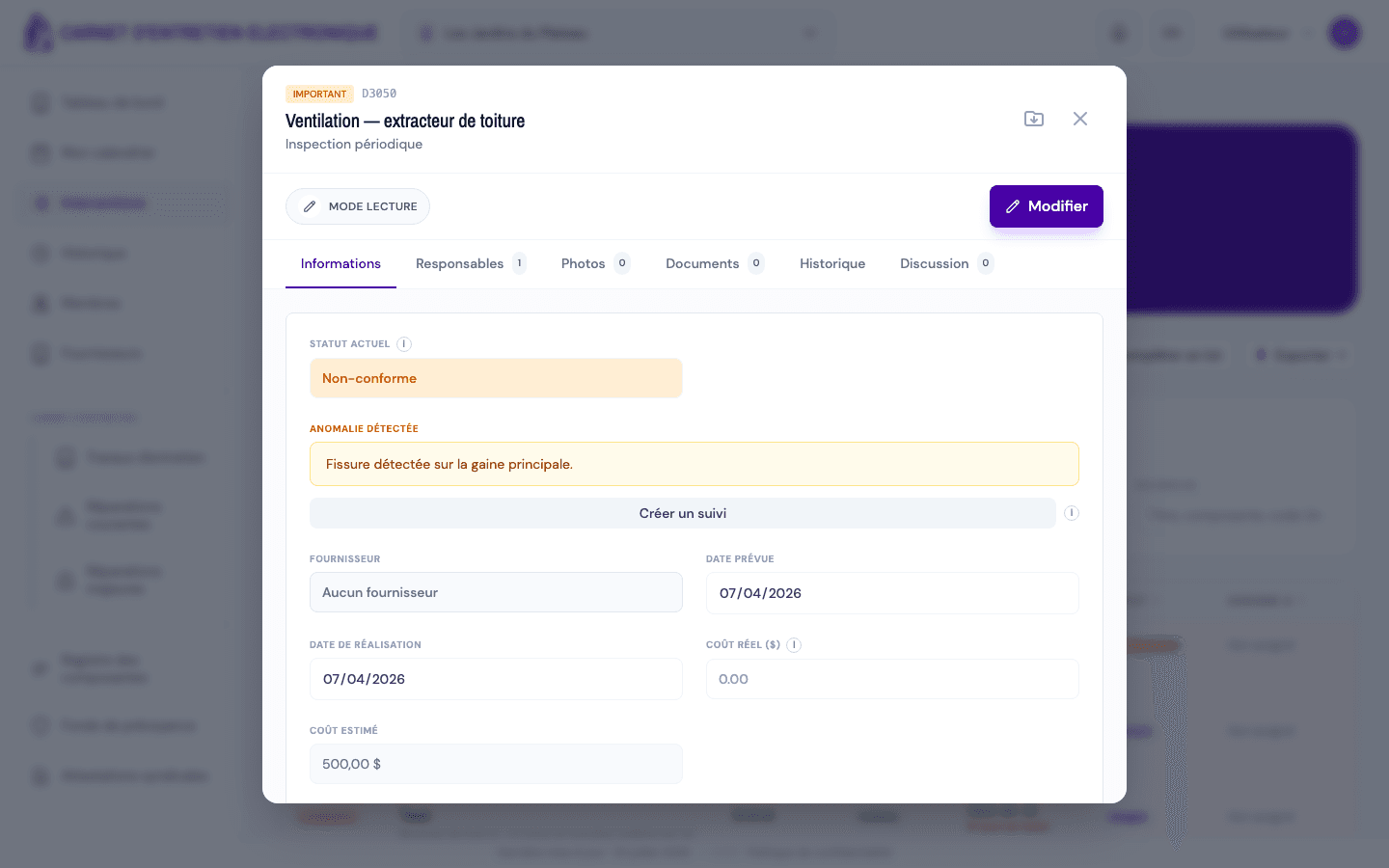
Open the non-compliant work order. In reading mode, the "Detected anomaly" section shows the description; below it, the "Create follow-up" button.
-
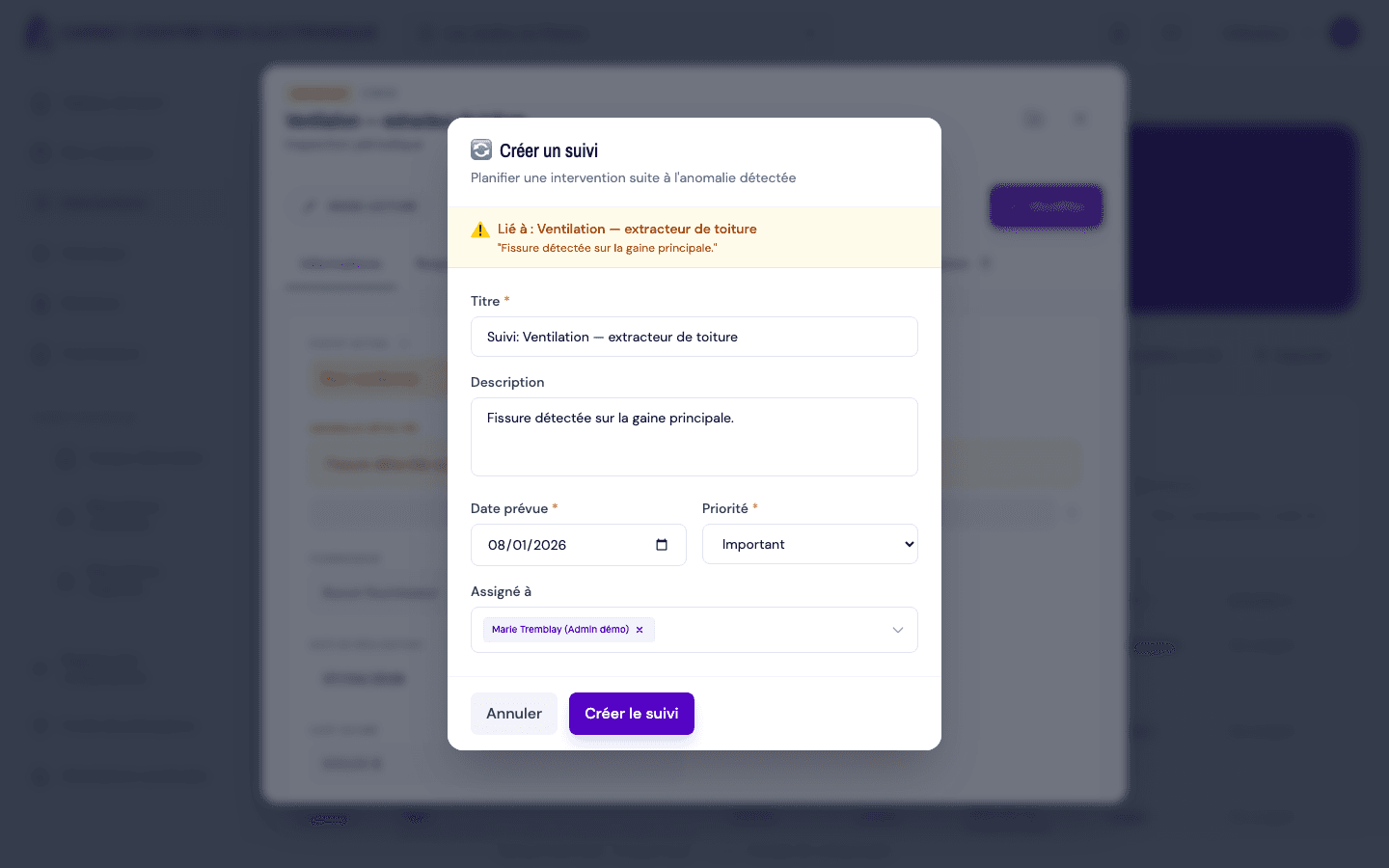
Click "Create follow-up". The dialog opens, recalling "Linked to: (work order)" and the anomaly.
-
Fill in the fields: "Title" (pre-filled, required), "Description" (pre-filled with the anomaly), "Scheduled date" (required, today or later), "Priority", "Assigned to".
-
Click "Create follow-up". A "Follow-up created" message appears.
Where to find the follow-up?
The follow-up appears in the work orders list as a new task, and stays linked to the original non-compliance, viewable both ways (see View the parent ↔ follow-ups link).
Tips and common errors
- Title and date required: without a title, or a scheduled date, creation is blocked.
- Not resolved: you can't create a follow-up on an already resolved non-compliance; resolving means the problem is fixed.
- Linking to a resolution: an existing follow-up can later be linked from the resolution form ("Link to a follow-up").
See also
Undo a resolution
Remove the resolution from a non-compliant work order to revert it to "unresolved non-compliant" and readjust the compliance counts.
View the parent ↔ follow-ups link
Navigate between a non-compliance and the follow-ups created from its anomaly, both ways ("Follow-ups created" on the parent, "Follow-up of" on the follow-up).