Features · Maintenance logbook
The maintenance logbook that keeps itself up to date
Updated July 20, 2026
A co-ownership maintenance logbook is the registry that describes the building’s components, the maintenance to be performed and the proof that it was done — a Bill 16 (Law 16) requirement for Québec syndicates of co-ownership. Carnet Condo turns that registry into an everyday working tool: every completed task adds itself to the history, with no retyping.
What Bill 16 expects from a logbook
Since the Regulation came into force in August 2025, the logbook must describe the common portions, plan their maintenance and record the work performed; it is established by an authorized professional, then reviewed every 5 years. Existing co-ownerships have until August 15, 2028. Carnet Condo’s role: keeping that logbook current day to day, between the professional’s visits. For the full picture of the obligations and dates, see our Bill 16 guide.
A registry of recurring tasks, not a list to retype
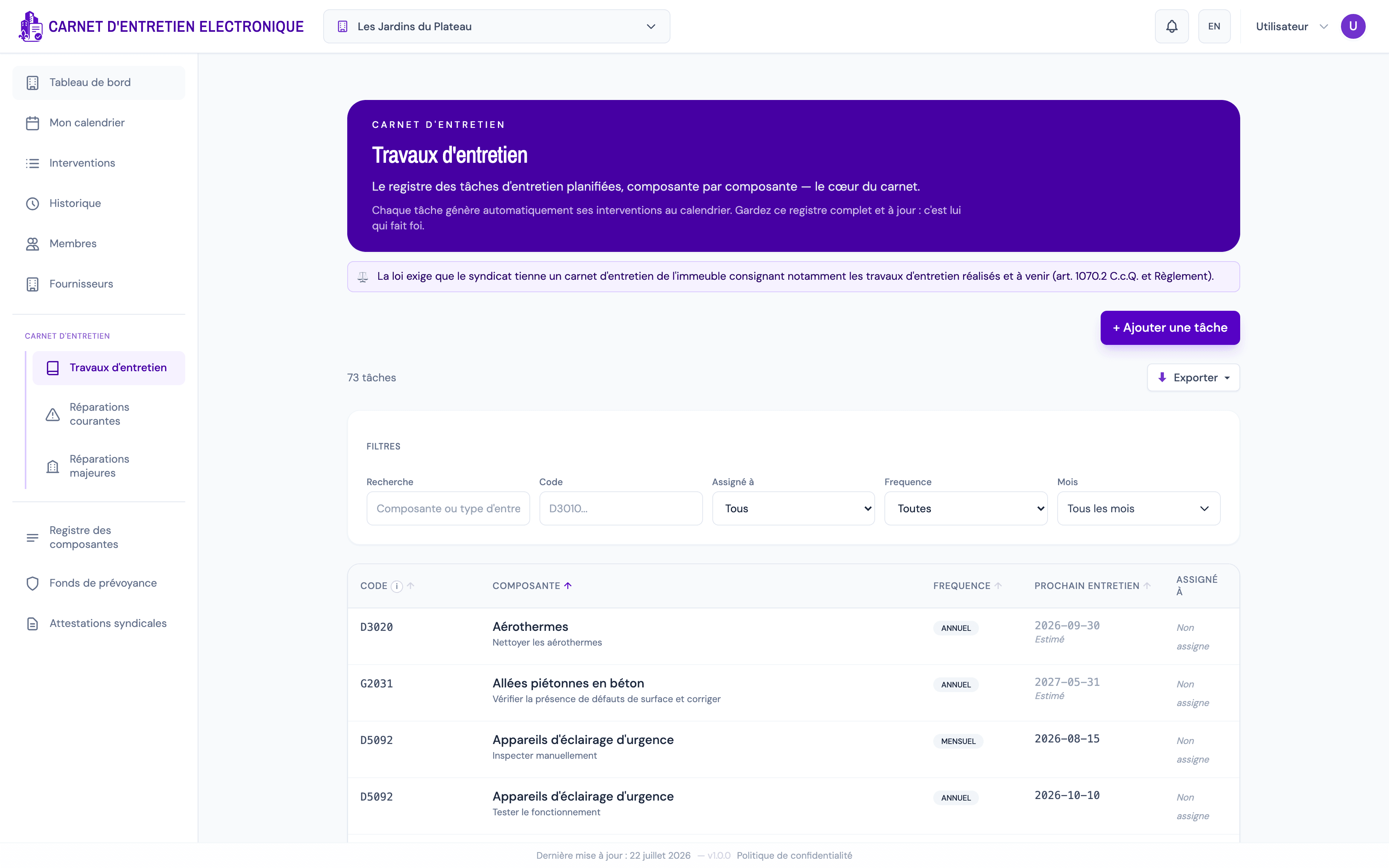
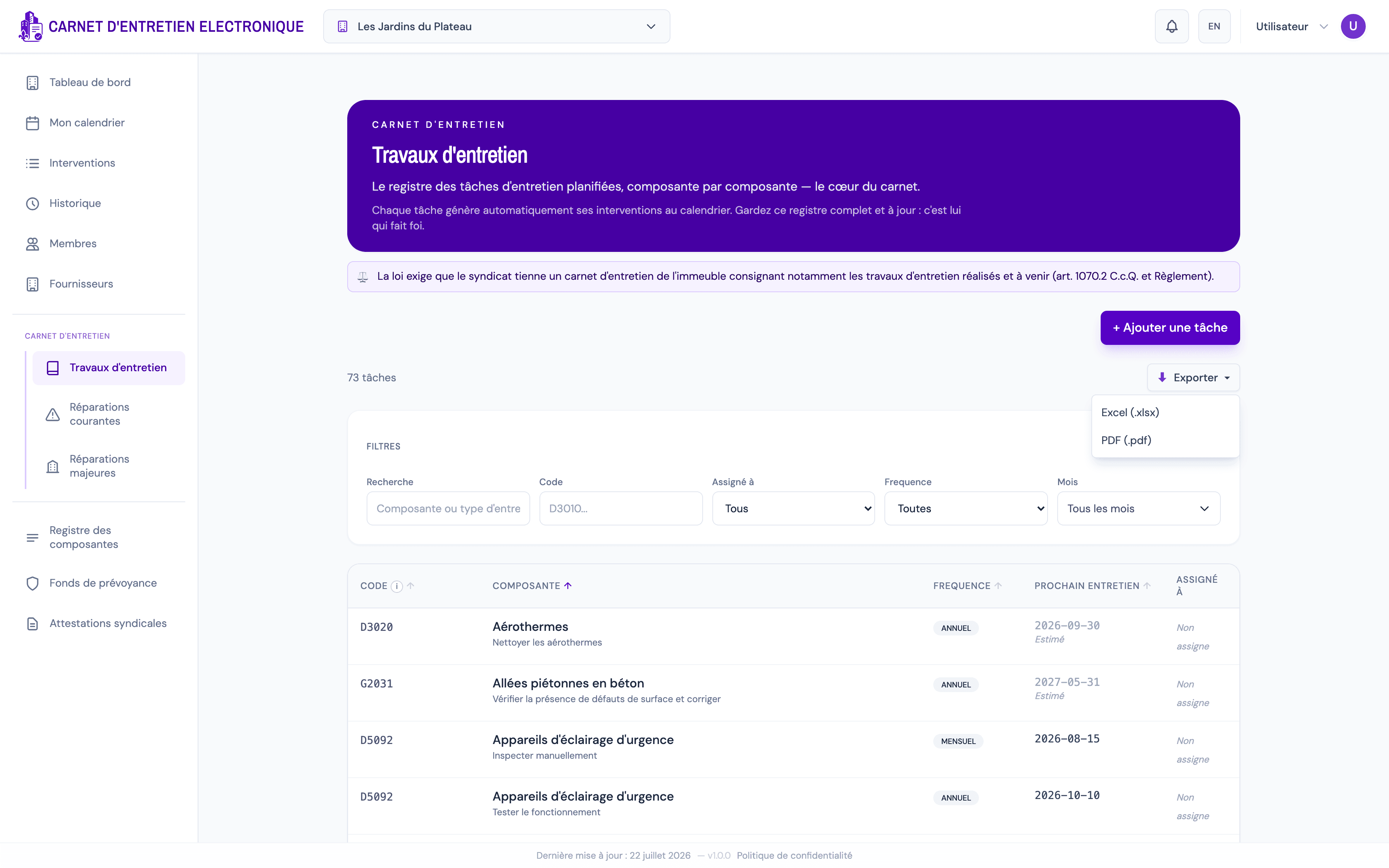
Every building component has its maintenance tasks with a Uniformat code, a frequency (monthly, quarterly, annual, multi-year or on demand) and assigned responsible parties. Carnet Condo generates the upcoming due dates and places them on the calendar: you define the task once, and it comes back on its own.
- Frequencies and priorities per task
- Assignment to board members or a supplier
- Filters by code, frequency, month or responsible party
A history that proves what was done
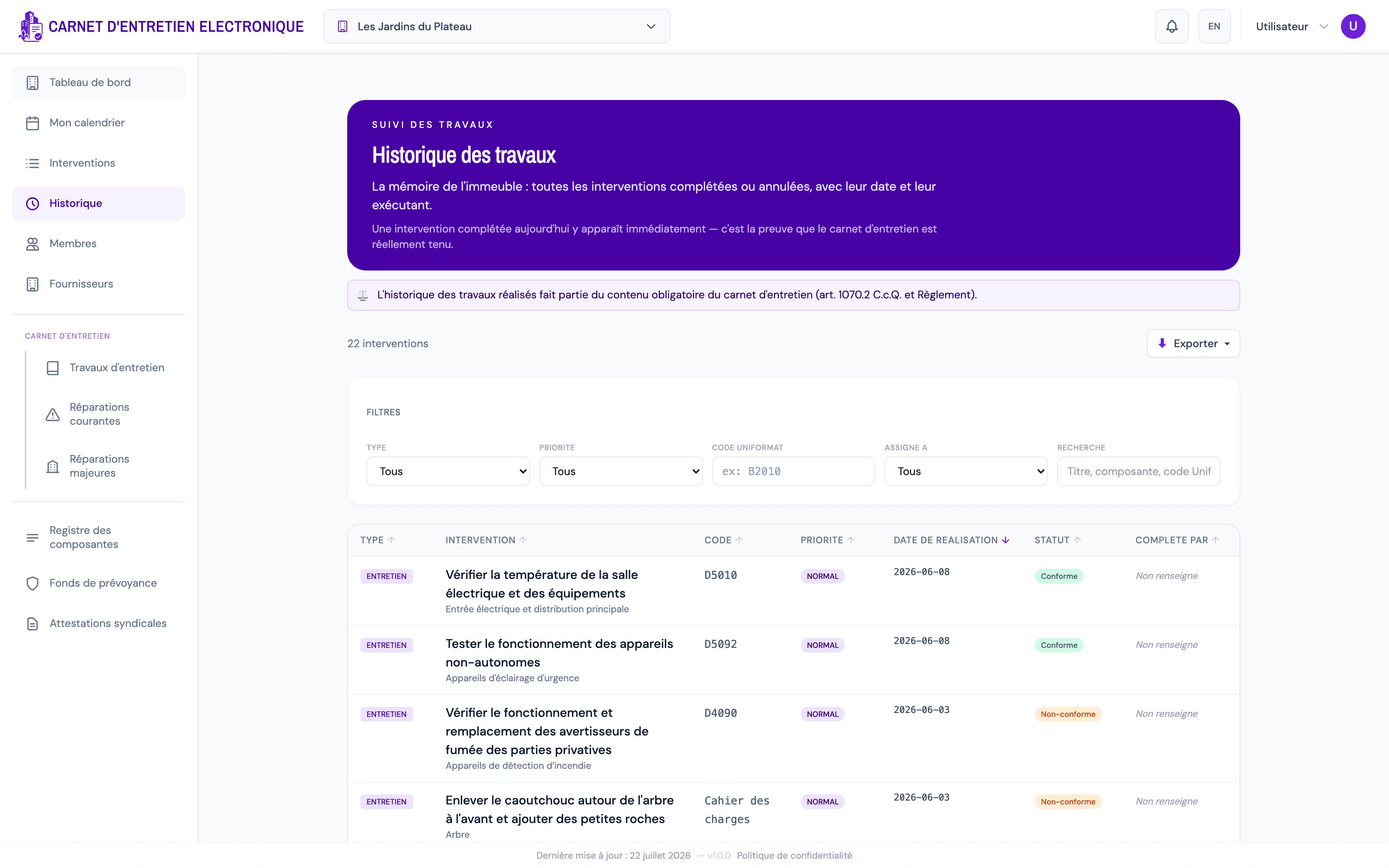
Bill 16 asks for more than a maintenance plan: it asks for a record of the maintenance actually performed. In Carnet Condo, every intervention keeps who completed it, on what date, at what cost, with supporting photos and documents. When a professional reviews your logbook, or a buyer starts asking questions, the history can be consulted and exported as is.
Non-compliant maintenance? The follow-up is created on the spot
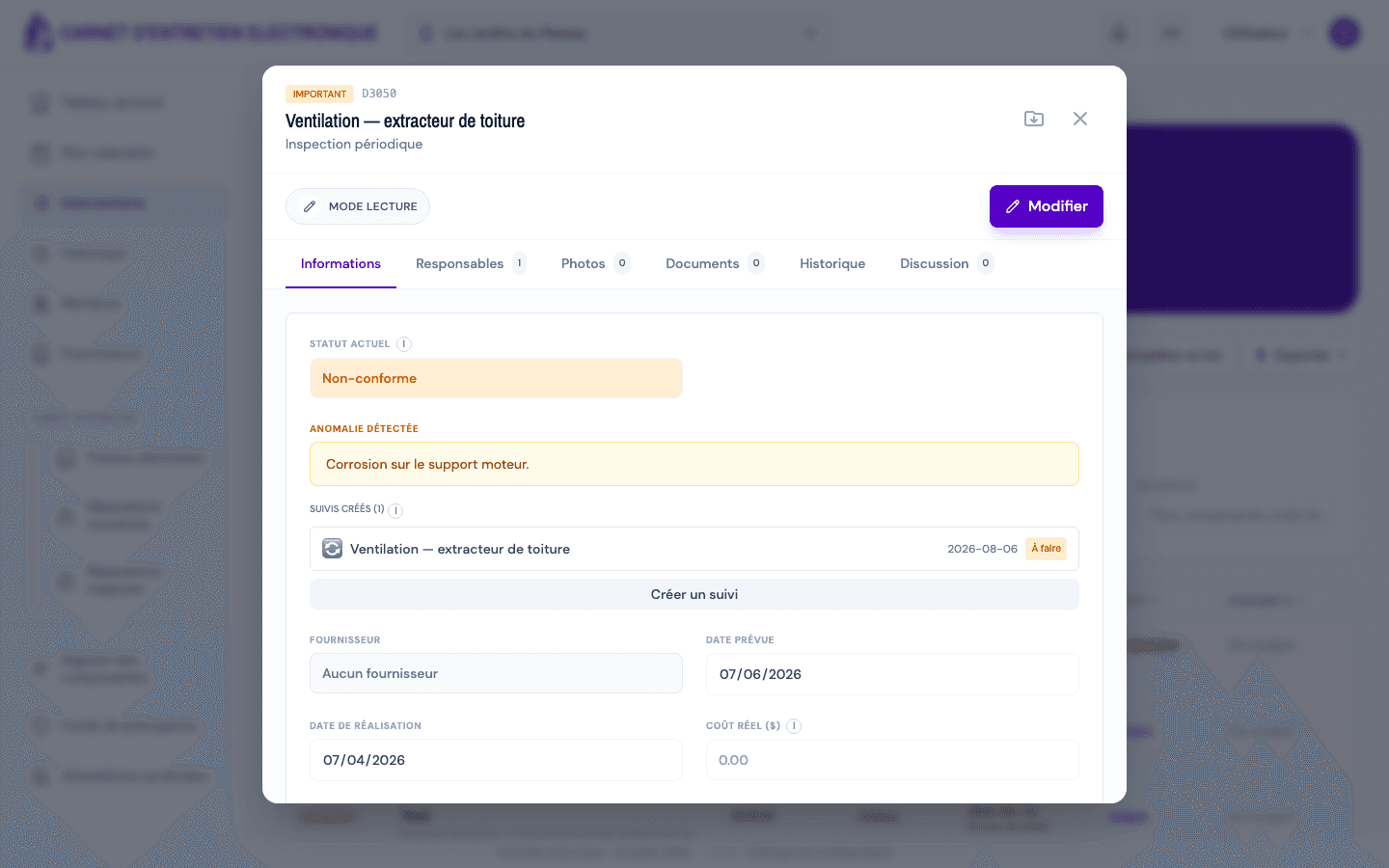
An inspection turns up corrosion, a leak, a part at the end of its life: the intervention is marked non-compliant, the issue is described, and a corrective follow-up is created right from the record. The follow-up stays linked to the original intervention until it is resolved: nothing slips through the cracks between two board meetings.
The component inventory, with condition and urgency
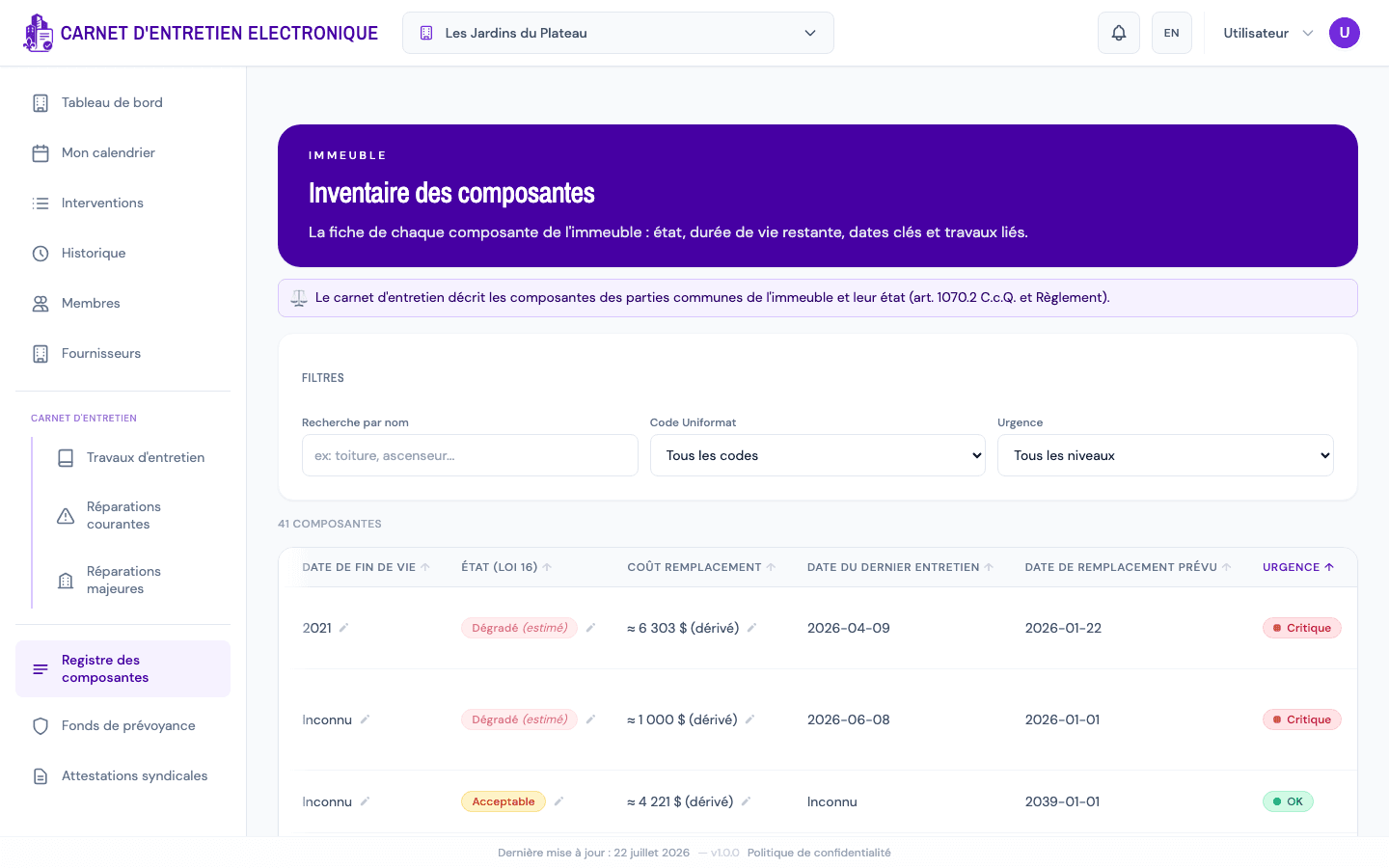
Roof, windows, water heater, elevator: every component has its own record with installation date, expected end of life, condition (good, acceptable, deteriorated) and replacement urgency. At a glance, the board sees what is nearing the end of its useful life — the essential input for planning the contingency fund.
Corrective work and major replacements
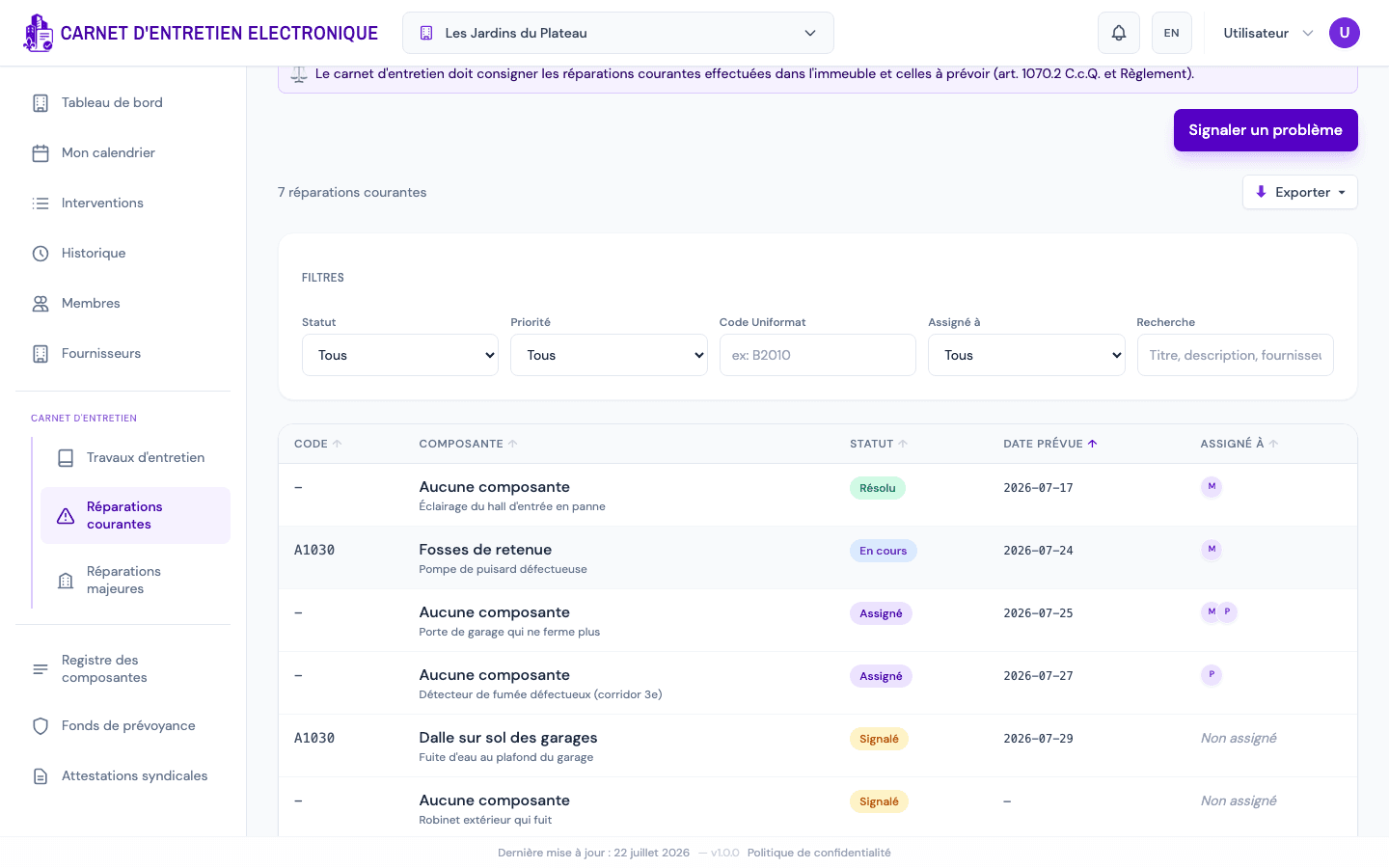
Not everything can be planned in advance. A problem reported by a co-owner becomes a corrective work item with a status, a priority, a responsible party and a checklist. Big projects (redoing the roof, replacing the elevator) are planned as major replacements, with an estimated cost and a funding source, and they feed the contingency fund projection.
PDF and Excel exports, ready to hand over
The logbook exports to Excel (components, Uniformat codes, recurrences, costs) and the work lists to PDF. For an external audit, the audit export gathers events, comments, history and attachments into a single file.
Paper, Excel or a digital logbook?
| Criterion | Paper binder | Excel file | Carnet Condo |
|---|---|---|---|
| Reminders for upcoming maintenance | None | None (you watch the dates yourself) | Calendar and due dates per task |
| History: who did what, and when | Handwritten notes, often incomplete | Overwritten with every edit | Time-stamped and preserved, entry by entry |
| Following up on a non-compliant inspection | Left to volunteers' memories | A “comments” column | Non-compliant status, linked follow-up created and tracked to resolution |
| Change of administrators | A binder to track down | A file to track down, multiple versions | Invite the new member — everything is already there |
| Document to hand to the professional or the meeting | Photocopies | The raw file | One-click PDF and Excel exports |
Frequently asked questions about the maintenance logbook
Is a maintenance logbook mandatory for a Québec co-ownership?
Yes. Bill 16 (2019) introduced the maintenance logbook requirement in article 1070.2 of the Civil Code of Québec, and the Regulation that spells it out has been in force since August 2025. Existing co-ownerships have until August 15, 2028 to put a maintenance logbook in place, which must then be reviewed every 5 years.
Who can prepare a co-ownership's maintenance logbook?
Under the Bill 16 Regulation, a co-ownership's maintenance logbook is established and reviewed by a member of an authorized professional order: OIQ (engineers), OAQ (architects), OTPQ (professional technologists) or OEAQ (chartered appraisers). Carnet Condo does not replace that professional: it lets the syndicate keep the logbook current between reviews and document every maintenance task performed.
Can you keep a condo maintenance logbook in Excel?
Nothing forbids keeping a maintenance logbook in Excel, but the file depends on a single person, sends no deadline reminders and keeps no record of who changed what. A digital maintenance logbook like Carnet Condo adds reminders, a per-person time-stamped history and sharing among administrators: exactly the elements that help demonstrate the traceability Bill 16 expects.
What happens to the maintenance logbook when the board of directors changes?
With an online maintenance logbook, a change of administrators loses nothing: new board members receive an invitation and find the component inventory, the planned tasks and the full work history waiting for them. That is one of the main advantages over a paper binder or an Excel file stored on a former administrator's computer.
The maintenance logbook is included in every Carnet Condo plan. Get started with your building today.